KIRA+:
New Autonomous
Public Transport
Project Launches
in the Rhine-Main Region
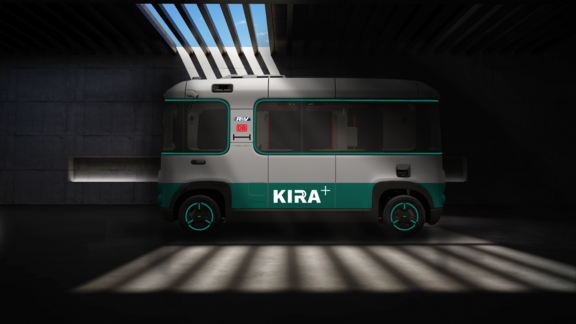
RMV, DB, and HOLON test autonomous on-demand transport with accessible vehicles / Project aims to prepare a model region for autonomous driving / Deployment planned in Darmstadt and the District of Offenbach / KIRA+ serves as a test field within the BMFTR-funded project MILA.mobility
The Rhine-Main region continues to lead autonomous mobility in Germany. With KIRA+, the Rhine-Main transport association (RMV), Deutsche Bahn (DB), and HOLON have launched a new project to test and establish autonomous driving within public transport. Preparations for test operations are currently underway. Initial mapping drives will take place during 2027 in parts of Darmstadt and the District of Offenbach, within the operating areas of local project partners HEAG mobilo and Kreisverkehrsgesellschaft Offenbach.
Prof. Knut Ringat, Managing Director of RMV, said: "With KIRA+, we build on our experience with autonomous driving and test refined technology in vehicles specifically developed for public transit. This brings us a decisive step closer to our envisioned model region across the RMV network. The objective is to integrate autonomous services into regular public transport in the near future. Autonomous fleets offer a tremendous opportunity, with appropriate political backing, to provide attractive, financially sustainable public transport everywhere and at any time."
Harmen van Zijderveld, CEO of DB Regio AG, stated: "Autonomous driving offers the opportunity for faster, more cost-effective, and fully digital mobility. To ensure that this technology genuinely relieves traffic rather than adding more cars to the roads, we must integrate autonomous vehicles purposefully into public transport. KIRA+ allows us to test precisely this integration, covering every requirement modern autonomous transit must meet. This ranges from accessibility for passengers with reduced mobility to dependable Technical Oversight in the control room under real operating conditions."
New vehicle for autonomous on-demand transit
KIRA+ deploys the barrier-free HOLON urban, equipped with autonomous driving technology from Mobileye. Designed specifically for public transport, the vehicle offers five passenger seats plus one dedicated wheelchair space during testing. When the wheelchair space is occupied, three passenger seats remain available.
Dr. Sven Herzig, Managing Director at HOLON, said: "KIRA+ marks a major milestone for us in Germany. Following Hamburg and Paderborn, the HOLON urban will now operate on public roads in a third German region. The driving factor for us is the overall direction. With RMV and DB Regio, two major players in German public transport are working toward a model region where autonomous vehicles become part of the regular transport offering at scale. This commercial scale is the benchmark by which autonomous mobility must prove itself. Reaching it requires vehicles engineered for continuous, heavy-duty operation, and that is precisely what the HOLON urban is built for."
KIRA+ paves the way toward a dedicated model region
The primary objective is the preparation of a model region for autonomous public transport. This defines a dedicated operating territory where autonomous mobility moves beyond isolated pilot trials to form an integral component of regular public transport services.
To achieve this, KIRA+ tests and evaluates self-driving vehicle operations and on-demand booking workflows, placing particular emphasis on scalability. Booking will run via a dedicated project app from ioki GmbH, which coordinates ride requests and pools them intelligently during route planning. Trained safety operators will remain onboard during all trips to supervise the SAE Level 4 operations.
The planned operational area builds directly on the predecessor project KIRA, which runs until the end of 2026. This setup allows the consortium to continue using existing operational assets, such as the central control room. Practical insights from KIRA and prior autonomous driving deployments will inform booking workflows, operational procedures, and vehicle specifications. KIRA+ will generate further findings for the future deployment of autonomous vehicles in regular transit, including operational routines for Technical Oversight.
Test field within the research project MILA.mobility
KIRA+ represents one of five test environments within the funded project MILA.mobility. The overarching initiative is funded by the Federal Ministry for Research, Technology and Space (BMFTR) and stands for "Middleware Integration of Control Room and Dispatch Systems for Autonomous Mobility." The project focuses on developing and harmonising a middleware architecture that links the essential software systems for autonomous transit, connecting the vehicle platform, fleet dispatch, and the central control room.
The KIRA+ project partners
As project initiator and regional transit authority, the Rhine-Main-Verkehrsverbund works to advance autonomous mobility with the goal of establishing comprehensive, attractive public transport across the RMV network and adjacent areas.
HOLON, a company of the BENTELER Group, supplies the vehicles with the HOLON urban. As the registered vehicle keeper, HOLON oversees vehicle-related approvals and maintenance, supported by DB Regio.
DB Regio holds responsibility for passenger transport licensing and the operation of the autonomous vehicles. This scope includes fleet management, Technical Oversight, operational domain management, and onboard passenger assistance.
The KIRA+ project builds upon the established innovation network from the previous KIRA initiative. Local transit operators Kreisverkehrsgesellschaft Offenbach and HEAG mobilo in Darmstadt are closely integrated as operational partners in their respective territories, where the KIRA+ trials will take place. The German Aerospace Center (DLR) provides scientific research support, while the Association of German Transport Companies (VDV) serves as the industry association partner.